
A Brief History to Western Art Music
The Classical Period (1730-1820)
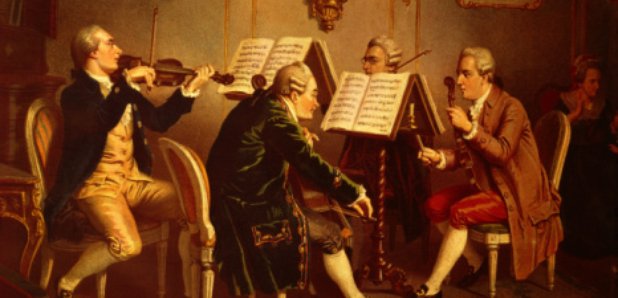
A string quartet of the Classical period.
Source: http://assets8.classicfm.com/2012/41/classical-period-string-quartet-1349964413-article-0.jpg
The Classical period was formed in the dying years of the Baroque period. Due to advancements in musical technology, namely the replacement of the harpsichord with the fortepiano (an early version of the modern pianoforte), more focus can be placed on fine musical nuances. As a result, music of the Classical period focused less on a complex texture and impressive grandeur but rather it was focused on elegance. Additionally, there was a greater range of instruments within a Classical orchestra. The Classical period redefined many pre-existing Baroque elements with its contrasting elegant style however the fundamentals of the Classical period were still heavily based on order, formality and hierarchy.
Key Characteristics
- Melodies were often based on a structure of 2 or 4 symmetrical phrases.
- Classical melody, rhythm and harmony were clearly balanced, emphasising the homophonic texture.
- Classical rhythm leaned towards metrical rhythm, influenced by European folk music. This metrical rhythm allowed composers to organise music in balanced phrases and cadences.
- Melodic and harmonic thinking were unified by the principle of tonality, placing equal focus on tension and resolution patterns of harmony on its melody (those two concepts relied equally and closely to each other).
- Less harmonic sequence than in the Baroque era though modulation may move well beyond the circle of closely related keys.
Classical music was able to focus on dynamic potential due to the fortepiano utilising leather covered hammers.
Key Composers

The Three Classical Legends
(left to right: Joseph Haydn, Wolfgang Amadeus Mozart, Ludwig van Beethoven)
(left to right: Joseph Haydn, Wolfgang Amadeus Mozart, Ludwig van Beethoven)
Image Source: https://clarinetbooks.files.wordpress.com/2012/07/klasika-w.jpg
The Classical period produced some of the greatest composers of all time who redefined music in their time and centuries to come. Stylistically, Mozart's music appeared to be more closely associated with melodic invention whereas Haydn and Beethoven used rhythmic motifs more often as a means of 'form building', along with sudden accents (strong and weak beats), syncopation and simple cross rhythms.
- Joseph Haydn (1732 - 1809)
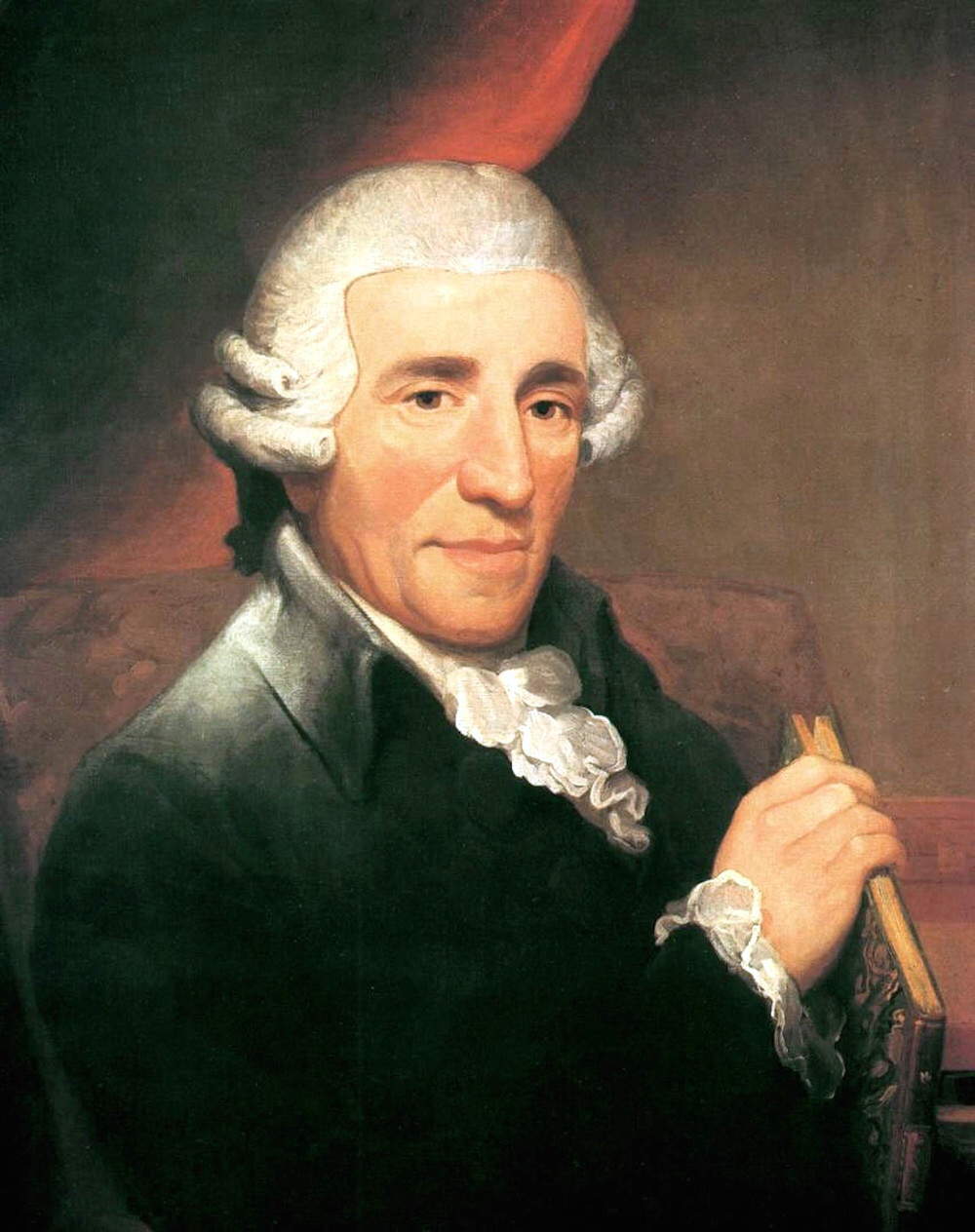
A portrait of the Haydn by Thomas Hardy (1792)
Image Source: https://upload.wikimedia.org/wikipedia/commons/0/05/Joseph_Haydn.jpg
Known as the 'Father of Symphonies', Joseph Haydn defined the musical forms being instrumental to the development of the Sonata form. One of the most celebrated composers in Europe in his time having served as Kapellmeister (the person in charge of music-making), Haydn was associate of Mozart and teacher of Beethoven who would both become one of the greatest composers of all time. Haydn's style most notably focused on simple thematic melodies or very short musical motifs.
Haydn's Symphony No. 45 in F-minor; The "Farewell" Symphony
- Wolfgang Amadeus Mozart (1685 - 1759)

A portrait of Mozart
Image Source: http://f.tqn.com/y/classicalmusic/1/S/8/mozart_portrait.jpg
Image Source: http://f.tqn.com/y/classicalmusic/1/S/8/mozart_portrait.jpg
Wolfgang Amadeus Mozart was a musical prodigy from a very young age, displaying prolific talent at the keyboard and violin at the age of three. By the age of five, Mozart was performing for European royalty. Born in musical family with his father Leopard being a Classical pianist, Mozart composed his first minuet at the age of five, his first symphony at the age of nine and his first opera was performed in Milan when he was fourteen. Improving on every musical form he wrote, Mozart composed over 600 works over the course of his lifetime. Mozart is described by music critics as being the greatest composer of all time, being a profoundly influencing Western Art music for centuries after his lifetime.
Mozart's Eine Kleine Nachtmusik (Serenade No. 13 for strings in G Major).
One of Mozart's best known works.
One of Mozart's best known works.
- Ludwig van Beethoven (1770 - 1827)
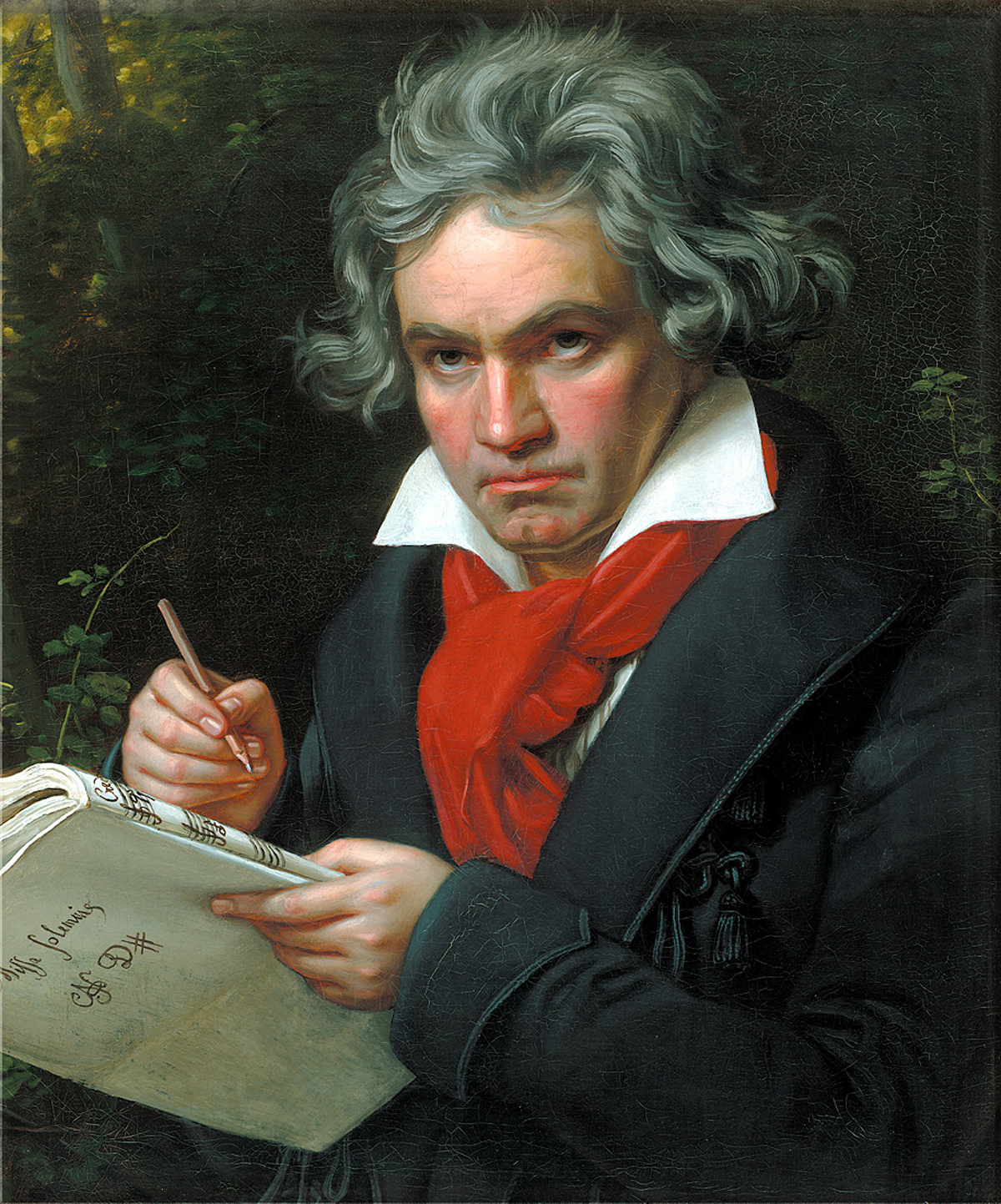
A portrait of Ludwig Van Beethoven by Joseph Karl Steiler (1820)
Image source: https://upload.wikimedia.org/wikipedia/commons/6/6f/Beethoven.jpg
Ludwig van Beethoven was the bridge between the Classical period and Romantic period with his later works featuring some Romantic notions which would be expanded upon in the Romantic period. Establishing himself as a virtuoso pianist under the tutelage of Haydn, Beethoven began composing his earlier works under the shadow of Mozart. However, his later works were cemented him as one of the greatest composers of all time and a key composer of the Classical period, combining what would become Romantic elements with Classical elements. These Romantic elements were born from Beethoven's own troubled personal life, with suggestions of bipolar disorder and his struggles with deafness. Beethoven displayed disdain for social rank and authority, a key notion of Romanticism.
Beethoven's fourth movement of his final symphony (Symphony No. 9 in D Minor)
The most famous piece of the Classical era, considered universally to be Beethoven's greatest work.
It is also considered by many to be one of the greatest compositions of the Western Art music canon.
The most famous piece of the Classical era, considered universally to be Beethoven's greatest work.
It is also considered by many to be one of the greatest compositions of the Western Art music canon.
Closing Thoughts
I, myself, believe without question that the aforementioned composers of this era defined the Western Art music canon. The intellectual depth in conjunction with the technical skill makes their works deceptively difficult to perfect. Where perfecting technical aspects alone of a Baroque piece would produce a 'passable' interpretation, doing so for a Classical piece would result in a mess. There are so many fine nuances in these pieces that even today, there is much debate on certain pieces by critics and performers on which interpretation would be most faithful towards the composer. For this reason alone, learning certain Classical pieces (in particular some of Mozart's and Beethoven's Sonatas) for me was extremely time consuming. Again, like the Baroque pieces, this could be the lack of relatability to the composer or the notions of that era. However, even after studying the piece and composer's life, the intended interpretation could quite often be a bit ambiguous.
When you do create an adequate interpretation (there will definitely be people who disagree with your interpretation as demonstrated by Daniel Barenboim, a concert pianist specialising in Beethoven who has had some critics claim some of his interpretations were completely wrong!), it is unbelievably satisfying. The feeling of a time of elegance; the quintessential Classical period.
Next: The Romantic Period.
Post by Wing


0 comments:
Post a Comment